Lane 1 of 3 · Workation
The remote-worker lane.
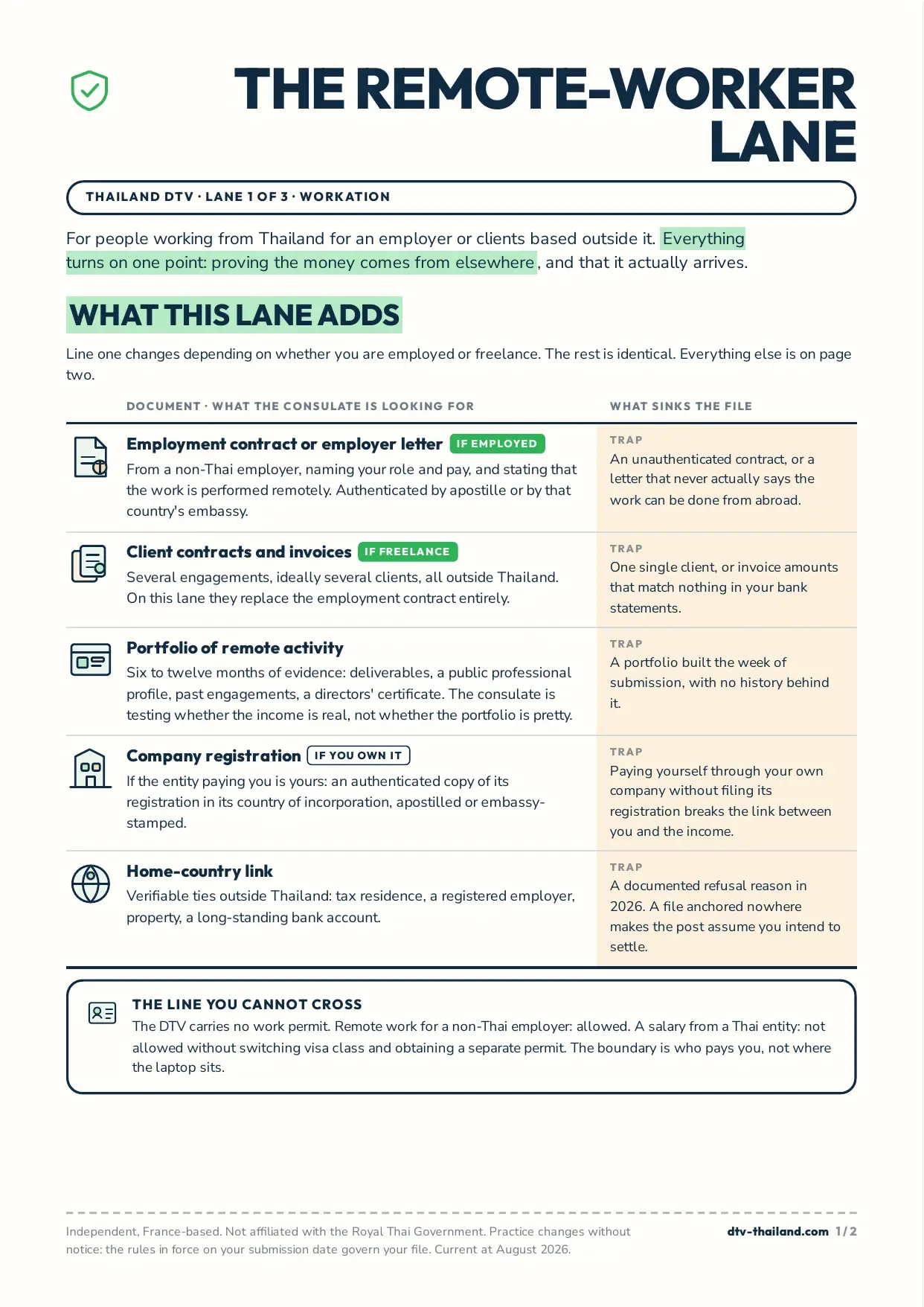
For people working from Thailand for an employer or clients based outside it. Everything turns on one point: proving the money comes from elsewhere, and that it actually arrives.
What this lane adds
Five documents, on top of the common base.
Employment contract or employer letterIf employed
From a non-Thai employer, saying the work is done remotely. Authenticated.
Client contracts and invoicesIf freelance
Several clients, all outside Thailand. They replace the contract entirely.
Portfolio of remote activity
Six to twelve months of real history, not a folder built last week.
Company registrationIf you own it
Authenticated copy, if the entity paying you is your own.
Home-country link
Tax residence, employer, property. A file anchored nowhere gets refused.
The line you cannot cross
The DTV carries no work permit. Remote work for a non-Thai employer is allowed. A salary from a Thai entity is not. The boundary is who pays you, not where the laptop sits.
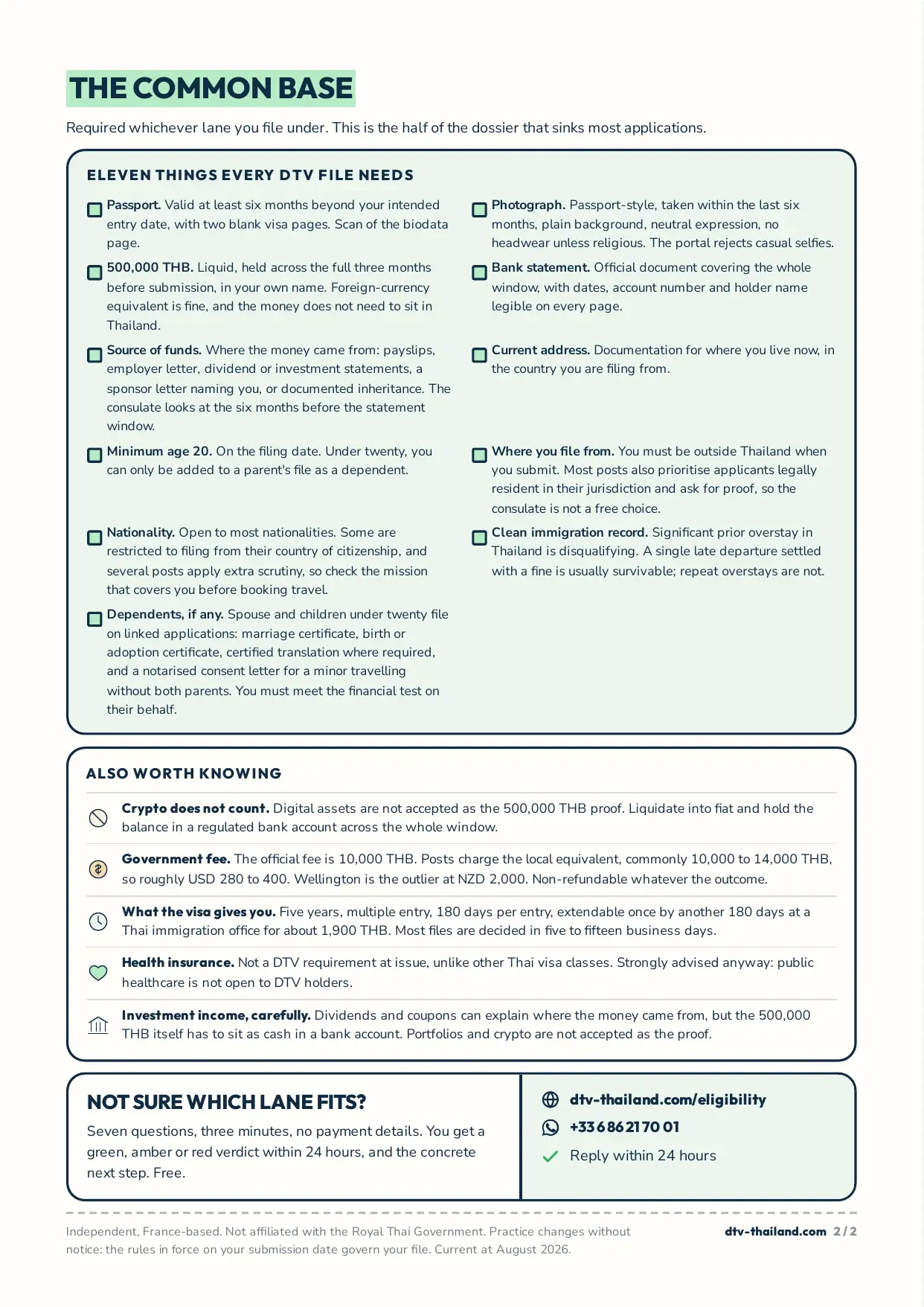
Twelve items · every lane
Then the common base.
The half of the dossier that sinks most applications. Page two of the one-pager below spells each one out.
- Passport, six months
- Photograph
- 500,000 THB
- Bank statement
- Source of funds
- Current address
- Minimum age 20
- Filed from your citizenship or residence country
- Criminal record certificate
- Eligible nationality
- Clean immigration record
- Dependents, if any
Changed on 31 August 2026
Two of the twelve are new or rewritten, and the printed guide below still carries the older wording. A DTV is now filed with the Royal Thai post covering your country of citizenship, or a country where you hold documented legal residence - not simply from anywhere outside Thailand. And every applicant now files a criminal record clearance certificate. The rule in full.
- What you get
- Five years, multiple entry, 180 days per entry, extendable once by another 180 days.
- Government fee
- $380 to $475 at most Western posts, $260 to $340 from several Asian ones. Your card, direct to the embassy. Full table.
The guide · two pages · free
Every document, every trap.
The sheet we hand our own applicants. Page one is this lane, page two is the common base. Print it, take it to the bank.
Current at August 2026. Updated when the rules change.
Six questions · three minutes · free
Not sure this lane is yours?
The quiz asks which lane you are on, then branches. A green, amber or red verdict within 24 hours, and the concrete next step.
Filing under a different lane? The soft-power lane · Spouse and children